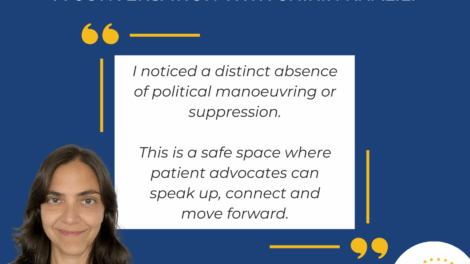

Janek Kapper is a Father, husband, brother, son, EUPATI Fellow and a member of the Estonian Medicines Agency Ethics Committee for Clinical Trials. He is also a passionate patient advocate whose personal journey has deeply influenced his professional mission. As the Founder of the Estonian Inflammatory Bowel Disease Society Janek also brings a rare blend of lived experience and systemic insight to his work.
Diagnosed with Crohn’s disease in the 90s, he has transformed his challenges into a lifelong commitment to improving the lives of people living with inflammatory bowel diseases. In our recent conversation, Janek shared his perspective on the evolving role of patients in research and policy, the importance of ethical collaboration in clinical trials, and how empathy can drive real change in healthcare. Let’s hear from Janek.
Could you share your story and your journey in patient involvement?
My journey started from a very personal experience. In 1996, I was diagnosed with Crohn’s disease – a time filled with pain, uncertainty and a long process of learning to live with a condition that never really goes away. Those early years were not easy, but they taught me empathy and patience.
Over time, I began to see that my own experiences could help others. I started to get involved in patient advocacy and collaboration, first at local level and then more broadly across Europe. Today, I am involved in several international projects such as ERA4Health, EU-X-CT, EFFECTrial, SAFEST, and ASSESS-DHT, and I also contribute to initiatives through the European Patients’ Forum (EFP) and IFCCA (International Federation of Crohn’s and Colitis Associations, formerly EFCCA).
These roles all share one common goal — to ensure that people living with chronic conditions are heard, respected and supported
Why did you enroll in the EUPATI Patient Expert Training Programme?
For me, EUPATI represented a bridge between lived experience and structured knowledge. I wanted to better understand how decisions in health research and regulation are made, and how patients can participate meaningfully in those processes.
It wasn’t about becoming an expert in science or policy, but about learning how to bring empathy, clarity and a human perspective into discussions that often feel very technical or distant from real life.
What was your experience of this training?
The training was intense and eye-opening. It gave me a deeper understanding of how complex the ecosystem around medicines and research really is — but also how much potential there is for positive change when patients are involved early and meaningfully.
What I appreciated most was the community. You realise you are not alone — that across Europe, there are people with different diagnoses, languages and stories, yet we share the same motivation: to make health systems more humane and fair.
You graduated last year as part of cohort 7, how have you brought your learning to help your work as a patient advocate?
The training helped me find a common language between patients, researchers and regulators. In my work at the Estonian Medicines Agency’s Ethics Committee for Clinical Trials, this has been especially valuable — understanding not only the regulatory side, but also how those decisions feel to the people affected by them.
EUPATI gave me tools to translate complexity into something understandable and respectful. It reminded me that ethics is not about saying “no”, but about finding responsible ways to say “yes” to progress — with empathy at the core.
Do you have any advice for people considering this training?
Be open-minded and honest about what you don’t know. EUPATI is not an exam to pass, it’s a journey that challenges how you see healthcare and yourself within it.
And remember: you don’t need to be the loudest voice to make an impact. Sometimes the most powerful contribution comes from quiet reflection and the ability to listen.
As a new member of the EUPATI Patient Expert Training Programme Training Committee plus your experience as EUPATI Fellow can better shape programme for trainees? What are the benefits of wearing these two hats for you?
It’s a privilege to give something back. Having recently completed the programme myself, I know how important it is to keep it practical, accessible and emotionally supportive. Knowledge is essential, but empathy is what makes learning meaningful.
Wearing both hats — as a Fellow and as a Committee member — allows me to bring the perspective of someone who has “been there” and understands the challenges trainees face. It’s about creating a space where people feel encouraged, not overwhelmed.
Do you have any words of wisdom for trainees who recently graduated as part of Cohort 8?
Celebrate how far you’ve come, but remember that graduation is just the beginning. The real work starts when you take what you’ve learned and use it to make small, steady changes in your communities.
Even if it sometimes feels like progress is slow, every empathetic conversation, every patient informed better, every form rewritten in clearer language — all of that matters.
What keeps you motivated on this road of patient involvement?
Empathy. It might sound simple, but empathy is what keeps me going. Knowing that my story, with all its ups and downs, might make someone else feel less alone — that’s enough reason to continue.
I don’t see patient involvement as activism or advocacy in the traditional sense. For me, it’s about human connection — building trust, understanding and dignity into systems that too often forget why they exist: to serve people.
Date posted: October 28, 2025
Categories: Testimonials