Estelle Jobson took the path less travelled years ago when she met with little or no information on her diagnosis of endometriosis. Instead of accepting the lack of knowledge surrounding this disease, Estelle was motivated to discover the answers herself.
After mastering the language of her condition, Estelle decided to become a EUPATI Fellow in a very new educational programme at the time. Undaunted by a challenge, she applied to be part of Cohort 2 of the EUPATI Patient Expert Training Programme. As a patient expert with an international background, along with her drive to learn, grow, collaborate and connect with other people, Estelle has become a formidable patient advocate. Let’s hear in her words her experiences so far.
Could you share your story and your journey in patient involvement?
It was the long and winding road, as the Beatles put it. It all began with my endometriosis diagnosis 17 years ago, in my country of origin, South Africa. The doctor who diagnosed me couldn’t tell me anything about anything. When I asked “What must I do now? How should I protect my health going forward?”, she literally shrugged at me.
Endometriosis is a horrible disease that chops great pieces out of one’s life, yet it’s invisible, so people tell you that you look right as rain. I was compelled to find the best tactics and tools to make the best of it, so I embarked on a quest to find out for myself.
I became increasingly clued up about my disease, joined a small patient support group which helped me psychologically, and was soon serving on the board of an international patient organization. This was incredible, as I worked on their information stand at big international conferences, interacting with specialists and researchers. In my free time, I devoured books, articles, and videos (including on how surgery is conducted – lasering, morcellating, stitching, the lot). In short, I learned a tremendous amount, which also raised many questions.
After about four years, I discovered that another level of patient engagement was out there – becoming a trained-up patient expert. That is where the EUPATI Patient Expert Training came along, at just the right moment. It was pretty exciting to have the chance to take my grassroots experience and disease-focused learning to a new level. Since I graduated, it has opened many doors, new skills, and career-related opportunities: combining health with communications.
On top of this, I underwent the lived experience of trial and error in disease management and care, with mixed results, from terrible to excellent. Living in South Africa, Italy and Switzerland has given me a global perspective on the stark differences in care, access, and affordability for my patient community. The playing fields are not even, to say the least.
How did you hear about the EUPATI Patient Expert Training Programme?
A scientist involved in women’s health met me doing my endometriosis advocacy, and she told me I was the perfect person to apply. That it was the next level I was ready for. Back then (the second cohort, 2015-2016), we had to put together a lengthy and convincing application, to stand out from hundreds of other candidates. We were competing for relatively few, precious places! I was quite daunted by the idea of learning all about the medicines life cycle, but was ripe for a challenge and keen to gain a new and different educational qualification. So I applied and was selected.
What was your experience of this training?
The online learning part was tough! Most of it was entirely new to me: the concepts, the terminology, the science, the European setting. To add to that, It wasn’t entirely clear to me how much of the learning would be applicable, but I powered on through it. I was working at 80%, was single and undistracted, devoting my after-hours time to this studying.
The face-to-face sessions of our cohort 2 were truly inspiring. There I realized I was not only learning facts, but joining a community of exceptional people, most of whom had lived experience of disease. People who had skin in the game, for whom it was not merely an intellectual exercise, but potentially life-changing for them and their patient communities.
Do you have any advice for people taking this training?
For the theory, roll up your sleeves. Keep your eyes down and power on through it! Just keep going. A great deal of it will make sense only later, when you get to apply it.
For the face-to-face meetings, stop and look up! Make the effort to connect with others, learn what diseases they are linked to, where they live, who they are. This is the perfect setting to meet incredible people, forge friendships, and build a wonderful network. The EUPATI Fellows network is amazing. You’ll get out what you put into it.
As part of an earlier Cohort 2 – do you think there has there been a lasting impact of this training? If so, in what way?
The training has had lasting impact, in that we are now 400+ trained–up EUPATI Fellows. Our qualification has become prestigious and widely recognized, and the opportunities for us to apply our knowledge have really grown from year to year. Everywhere I go, I bump into EUPATI Fellows and see their work evolving. It’s wonderful to be a part of this community and to follow its growth.
As an active patient advocate, what are main your focus areas?
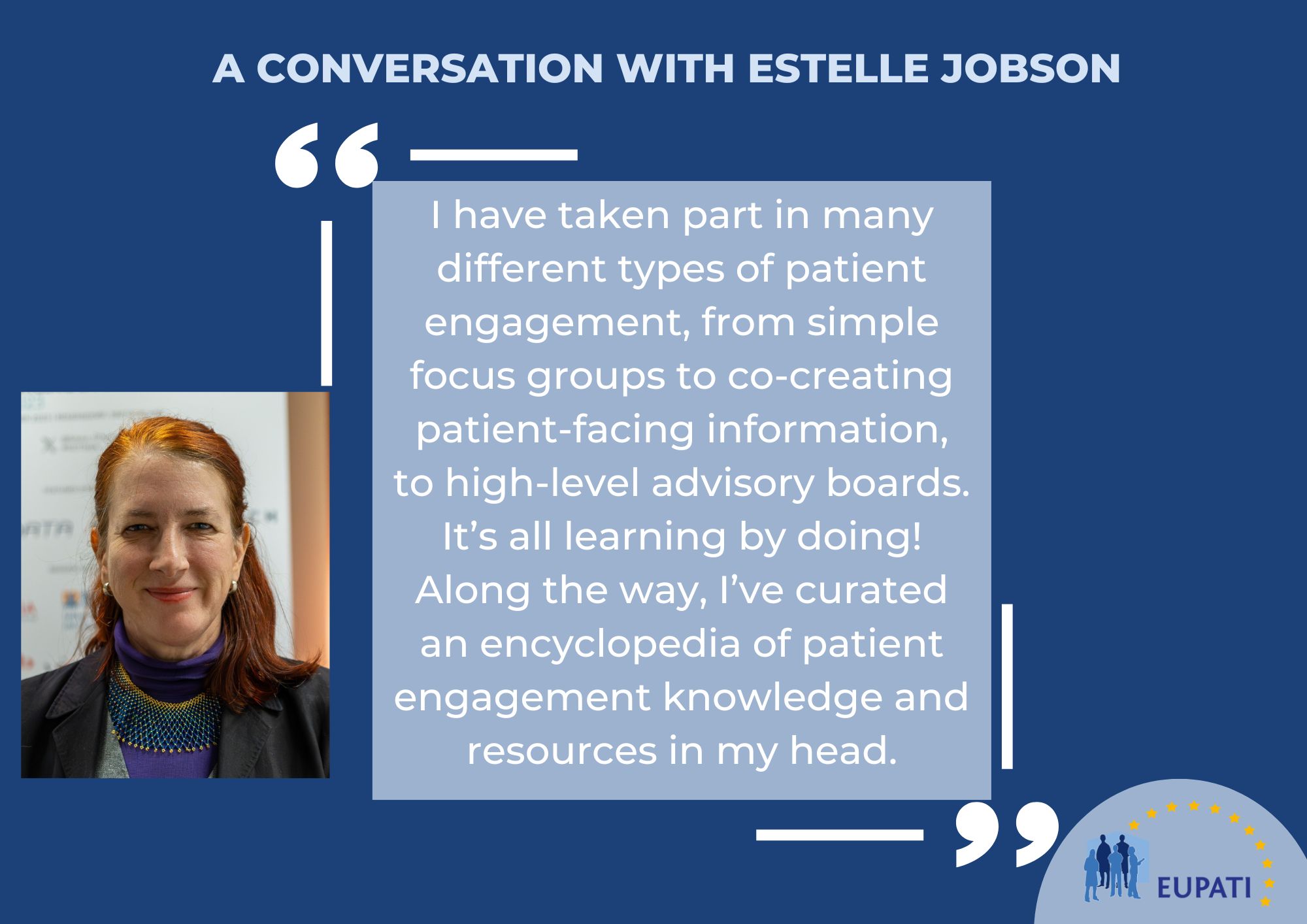
I’ve taken part in many different types of patient engagement, from simple focus groups, to co-creating patient-facing information, to high-level advisory boards. It’s all learning by doing! Along the way, I’ve curated an encyclopedia of patient engagement knowledge and resources in my head.
From 2019 onwards, I’ve been a founding member of a working group at the Geneva University Hospitals (HUG), dedicated to integrating patient and public involvement in the R&D being carried out by researchers and hospital-based investigators. This group, PartnerREC, has grown from strength to strength, and we created and now regularly co-teach a training course in French for patients and researchers. This work has been exciting, because we started it from scratch, and we are known as pioneers in our country now. At the hospital, I’m also a patient partner in a group that assesses all the patient-facing materials, brochures and posters in the pipeline, which makes for fascinating reading and a chance to keep things grounded and patient-centric.
On the other side, interacting with pharmaceutical companies, I have had many different roles and served on several advisory boards Notably, after two years on a patient expert board with Servier, I became lead author of the resulting case study, published open access in the peer-reviewed journal, Research Involvement and Engagement.
At present, I’m serving on an advisory board with Boehringer Ingelheim, devoted to developing diversity, equity and inclusion in their R&D and trials. In this context, I am bringing my perspective on women’s health and the gender health gap, as well as my communications expertise.
Then there are ad-hoc opportunities that come along, that I take on according to the topic and my availability.
How do you find time for all your activities and be kept informed?
It’s a challenge to keep up! There is so much happening and I’m interested in so many topics! Going to conferences, often invited as a speaker, gives me an opportunity to catch up on the latest developments, to hear about new publications and case studies.
In my ordinary life, I often listen to podcasts and replay presentations while cleaning, walking or cycling. Then, don’t forget real people. I find that balancing reading and thinking with talking to real patient advocates about their work keeps it human, real, alive.
What keeps you motivated to drive your patient advocacy forward?
Interacting with other patient advocates keeps me in touch and inspired. I enjoy hearing what they are achieving for their patient communities, and – on a more personal level – how they are coping with their daily lives, despite their health troubles. That this field is constantly involving keeps me fired up, too. I’m looking forward to seeing how patient engagement develops in the years ahead and am proud to be part of it. Both looking back and looking forward keep me motivated. How far have we come? What awaits us around the corner?
Date posted: April 29, 2025
Categories: Uncategorized