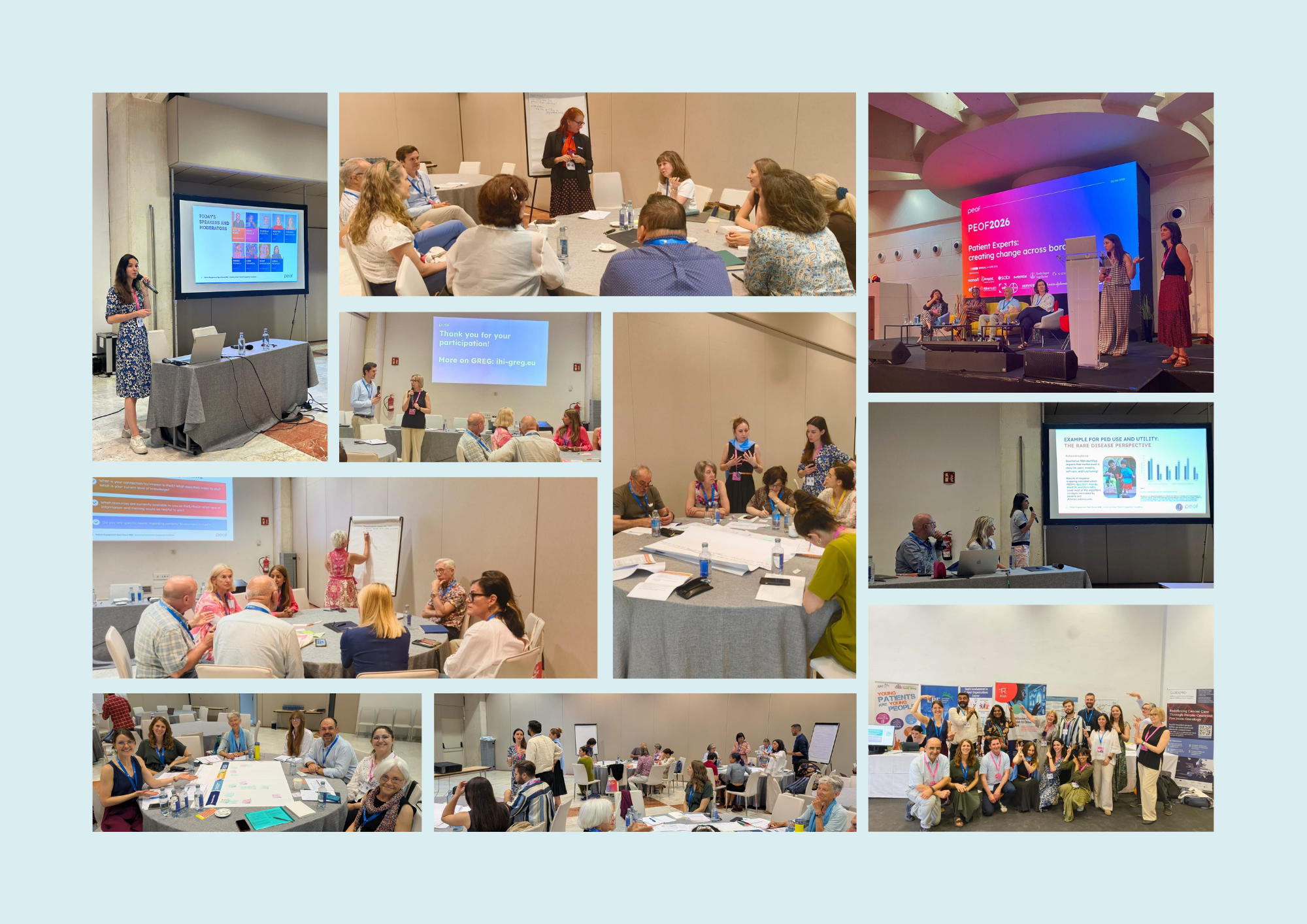
At this year’s Patient Engagement Open Forum (PEOF) in Sevilla, Spain, EUPATI led and co-organised many sessions exploring what it takes to turn lived experience into meaningful, measurable change. Here’s a condensed look at each.
Integrating the Future of Patient Experience Data (PED): From Patient Voices to Real-World Impact
Clinical trials are built to reward numbers, but much of what matters most to patients — daily burden, what a side effect feels like, why someone quietly drops out — comes through as stories, not data points.
This session tackled how to validate qualitative patient input as rigorously as quantitative endpoints, without losing its richness. In the room, the group worked through real cases like an oncology trial where patients reported “brain fog.” The emphasis on this session was on solution-focused outcomes, not debating whether patient stories belong to trials but understanding how to scale them, when to collect them and how to get scientists to adapt their methods.
Speakers of this session were Tamás Bereczky, Inês Alves, Sanja Njegic.
Key takeaways from this session included:
- Patient stories need a standardised method, validated methodology across Europe and not an add-on to existing questionnaires.
- The goal is better measurement. Narrative data should sharpen trial endpoints, not replace them.
- Ask earlier and ask openly. Input should be collected earlier, with open-ended questions that catch the unexpected. Dropouts should be treated as data and not gaps. There is a need to understand why people drop out.
- Real barriers, real momentum. There is need to get scientists on board to help the workload of genuine inclusivity. There is a risk of flattening rich stories into bare summaries.
Next Step Recommendations
Pilot new-style exit interviews and patient-reported outcome measures, update protocols to cover post-dropout follow-up, involve patients from the start of trial design, and push for one standard validated way to gather patient stories across European trials.
Patient Experts: Creating Change Across Borders
This panel and World Café session moved past whether patients should be at the table to ask who is still being left out — and why. This interactive session sought to confront an uncomfortable truth head-on: current models of engagement are still failing to reach many of the communities most affected by health inequity.
Our group of EUPATI Fellows shared candid, cross-border reflections on the structural gaps in current engagement models. The energy in the room was candid and constructive as participants were encouraged to name uncomfortable truths rather than default to polished success narratives. This resulting in a rich exchange of real-world experiences and tensions.
Speakers from this session (all EUPATI Fellows) were Clarinda Cerejo, Cristin Lind, Mitchell Silva, Rachel Ogola.
Key takeaways from this session:
- Exclusion is structural, not incidental. Participants agreed that current models of patient engagement will never reach excluded communities if the way we work does not fundamentally change.
- Fragmentation between patient organisations weakens collective impact. Patient organisations are often working in silos rather than as a united force, competing for limited resources rather than building alliances.
- Social determinants, and structural imbalances are still overlooked. Health literacy gaps still determine who gets a seat at the table.
- Not everyone wants to be involved. Some excluded communities do not necessarily want to be involved. This is often due to competing priorities like housing or financial hardship. This is valid and that’s okay.
- Momentum exists alongside the barriers. Despite naming the uncomfortable truths, participants left with a renewed sense of commitment to collaborate across borders.
Suggested next steps:
The session concluded with clear actionable steps for the group to work on. These included: meeting people where they are, in their community with trauma-informed and community-based approaches. Identify and support local champions who can handle exposure, break the ice, and open doors for others. Build alliances instead of competing, with patient organisations working together instead of silos. Rethink what “participation” looks like and to include oral narratives and peer support models.
These themes will feed into ongoing EUPATI work on inclusive engagement practices, and Fellows are exploring how to formalise some of these actionable changes into practical resources for national platforms and partner organisations.
Inspiring Change Globally: How Can We Best Apply the EUPATI Patient Engagement Model to Address Neglected Populations Around the World
Patient education is not a one-size-fits-all model: what works in a high-resource setting can fail entirely elsewhere, shaped as it is by language, literacy, disease context, and trust.
This joint EUPATI-DNDi (Drugs for Neglected Diseases initiative) session set out to explore what patient education truly looks like when the context changes completely. Such changes include a different language, a different health system, a different disease, a different level of trust. We were delighted to be joined by speakers from Africa, South-East Asia, and Latin America who shared on-the-ground experience engaging communities affected by neglected diseases.
Participants were asked to actively listen and capture the challenges raised across four themes – access, comprehension, trust and power, and health-system fit – using coloured post-its. These were then organised into flipcharts by theme and used to open a facilitated discussion with the wider audience.
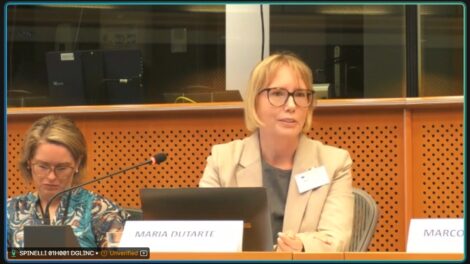
Our moderators for this session was Craig Tipple, Maria Dutarte, Estelle Jobson, Laia Bisbal Arnal and our panellists were Ivy Dimarucut (Singapore), Rajni Kant Singh (India), Helena Esteves (Brazil), Vanessa Apea (Ghana/UK).
Key takeaways from this session:
- Access is shaped by cost, time, age, gender digital access, and caregiving demands and not just distance. Cost of care should not be a luxury, but an essential service. As some communities are small in number, tailored approaches are needed to reach them. Patient-facing materials need to be accessible and co-created by the community itself
- Effective engagement depends on whether people can relate to information. Do they understand, relate to, and feel confident engaging with information, not just whether it is technically accurate? Accuracy plays a part, but relatability is also a vital factor. Oversimplification can also be harmful. This aspect also needs to be considered.
- Trust is slow to build and easily lost. It is shaped by past experiences, relationships, and who holds influence. Therefore, gatekeepers should be seen as relationships, not barriers.
- Engagement is only meaningful if the health system can respond with functional pathways, appropriate services, and alignment to local realities.
Recommended next steps:
This session reinforced the idea that inclusive patient involvement is not a single intervention but a systematic approach. To create the systematic approach there is a need to complete the following:
- Anchor engagement in functioning clear referral pathways which translates to real accessible outcomes.
- Prioritise education before prevention, to ensure communities are genuinely equipped to participate in decisions that affect them.
- Invest in co-created non-written materials that reflect local literacy levels and cultural norms.
- Recognise and strengthen the role of community health workers as trusted partners.
- Build engagement models that account for instability, ensuring approaches remain relevant and adaptable in contexts shaped by conflict, health system failure, or resource scarcity.
Science-Informed Advocacy in Vaccine R&D: Role of Patient Community Leaders Enhancing Patient Involvement in Vaccines Development and Roll-out
Vaccines remain among the most effective public health tools available, yet the process behind their development, evaluation, and rollout is still poorly understood by the communities most affected by it.
This multi-stakeholder roundtable asked where the patient voice truly belongs in vaccine R&D, and whether current engagement is meaningful or symbolic — drawing on lessons from COVID-19.
Our speakers for this session were Giorgio Barbareschi, Daniela Rojas Castro, Charlotte Vernhes, Beatriz Mothe Pujadas.
Key takeaways from this session:
- Vaccine R&D lags behind therapeutic R&D on patient involvement, partly because trials traditionally involve healthy populations. Therefore it is still catching up on meaningful patient involvement.
- Exclusion creates a self-reinforcing cycle. Immunocompromised patients are among those who need vaccines most, are frequently excluded from early trials. This leads to a deepening mistrust.
- Science-informed advocacy has a proven track record. The RSV patient community offered a compelling example of what this can look like in practice – from co-authoring grant applications to improving the readability of patient information forms and supporting recruitment and retention in trials.
- Trust can’t be built during a crisis; COVID-19 demonstrated both the power of patient advocates as trusted communicators and the cost of engaging communities too late. Preparedness must happen beforehand.
- Misinformation remains a central barrier. There needs to be a clarity about who is responsible for communicating about vaccines, who communities actually trust, and what tools and language genuinely work across different populations.
What are the recommended next steps?
Vaccine literacy is not simply about what people know – it is about whether they feel seen, heard, and respected throughout the R&D process. These aspects can be achieved by engaging communities earlier, expanding inclusive trial design, scaling proven models like the RSV patient community’s advocacy work, and clarifying roles in vaccine communication. The session also called for a continual cross-stakeholder dialogue.
Real-World Evidence and Data: Aligning Expectations with Training Needs
We also co-facilitated in this dynamic workshop alongside our IHI-GREG project partners. As Real-World Evidence (RWE) and Real-World Data (RWD) continue to play an increasingly important role in healthcare decision-making, it is vital that all stakeholders, including patients, have the knowledge, skills and confidence to engage meaningfully in these concepts.
One of the most striking moments was the question that kept surfacing in different forms: not just how do we collect real-world data, but why, for whom, and who owns it?
Our speakers for this session were Mariam Bibi, Alejandro Puigrefagut Pla, Estelle Jobson, Mandy Daly, Maria Dutarte.
Key insights from the session:
- Not all data is good data. Data collection needs to be purposeful and grounded in a clear research question, a defined stakeholder, and a commitment to adding value.
- Important data is being lost. Adverse events, for example, are often underreported or misreported – not because patients are not observing them, but because they may not have the clinical language to describe them in a way that gets captured correctly.
- RCTs are not always feasible or ethical particularly in ultra-rare diseases where patient populations are simply too small. This is precisely where RWD has an irreplaceable role.
- Patient organisations are already collecting data. It is often considered not robust or not in the format required by agencies. The answer is not to dismiss this data, but to co-create, collaborate and combine it with other sources..
- The question of data ownership was front and centre. What would it take for patients to truly be in the driver’s seat when it comes to real-world data?
- There is no universal infrastructure. Data storage, ethical review processes and governance vary enormously across countries – and some lack the infrastructure entirely.
- The link between evidence-based advocacy and RWD is strong and underexplored. Patient organisations need methodology, training and mentorship to develop their capacity in this space.
The session also highlighted that different stakeholders – patients, academia, industry, HTA bodies who come to RWD with different endpoints and expectations. However, they often share the same underlying goal. Bringing them into the same room to learn from each other is not a nice-to-have. It is the starting point. This is exactly the gap that IHI GREG aims to fill.
Across all sessions, a common thread emerged: patient engagement at PEOF 2026 was less about proving patients belong in the room, and more about confronting how to make that involvement genuinely meaningful. Our conclusions are that patient involvement needs to be methodologically rigorous, structurally inclusive, globally adaptable, and built on trust established long before it’s needed.
A heartfelt thank you to every participant, facilitator, and speaker whose contributions brought these sessions to life. It’s been a privilege to create this meaningful space for sharing ideas, presenting our work, and learning from each other!
Date posted: August 31, 2026
Categories: Uncategorized